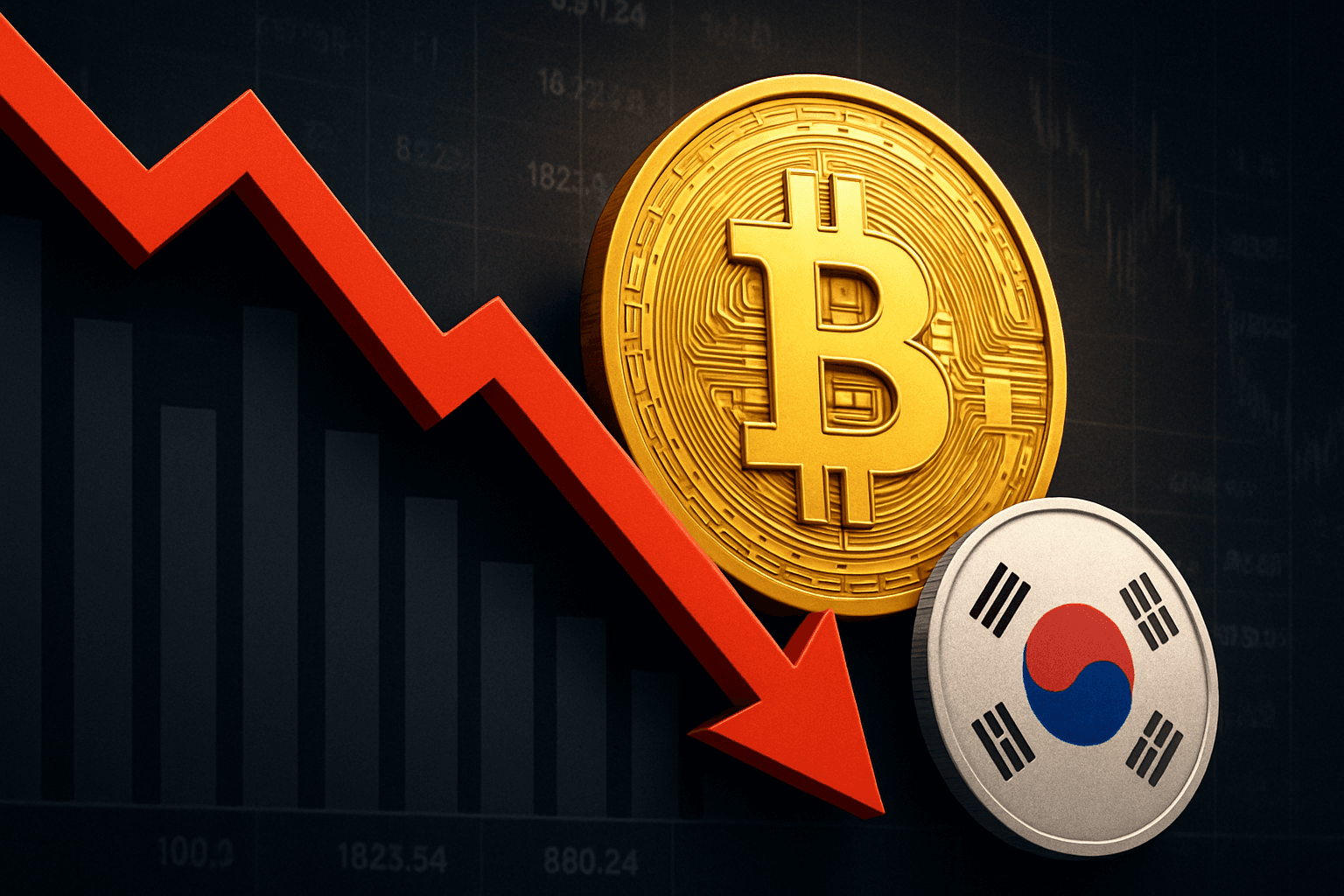
South Korea crypto trading volume drops 54.6% in first half
A late-July stock-market rout briefly lifted crypto turnover, but won-based exchange activity remained subdued as extreme swings in semiconductor shares pulled retail attention toward equities.
Trading on South Korea’s five won-based cryptocurrency exchanges totaled about $366.58 billion in the first half, down 54.6% from a year earlier, as domestic retail activity stayed weak and liquidity continued to concentrate on Upbit. From July 1 to 30, the five exchanges handled $13.87 billion, or about 20.39 trillion won, with daily average turnover of 679.7 billion won, rising to 702.7 billion won when matched to KOSPI trading days, equal to just 1.94% of the stock market’s 36.27 trillion won daily average. The latest figures show crypto losing its traditional appeal as South Korea’s high-volatility retail trade shifted toward equities, particularly Samsung Electronics and SK Hynix, whose swings outpaced Bitcoin’s relatively subdued movement around $65,000. From July 1 to 30, the KOSPI’s average daily absolute change was 4.27%, versus 5.44% for Samsung Electronics and 6.85% for SK Hynix, while the index fell 32.6% over the period. Crypto volumes weakened through mid-July, then rebounded late in the month as the stock selloff intensified. Daily average turnover across the five exchanges dropped from 703.1 billion won on July 1-10 to 523.2 billion won on July 11-20 before recovering to 812.9 billion won on July 21-30. The pickup was concentrated around July 28-29, when the KOSPI plunged and exchange trading rose to 1.42 trillion won and 1.22 trillion won respectively, before falling 66.5% to 409.6 billion won on July 30. Market observers say the pattern points to a temporary reaction to stock turmoil rather than a broad recovery in crypto trading. The slowdown comes as Upbit’s market share has risen while smaller exchanges seek new revenue sources and as Finance Minister Koo Yun-cheol has confirmed crypto gains will be taxed from Jan. 1, 2027 after three previous delays. The stock-market volatility also exposed rising concentration risk among retail investors, with Samsung Electronics and SK Hynix accounting for 86.9% of individuals’ total net buying during the period through July 28, before a record KOSPI rebound on July 31 triggered heavy foreign buying and retail selling.
- liquidity: The ease with which an asset can be traded without causing a large move in its price.
- price discovery: The market process through which trading helps determine an asset's current value.
- stablecoin liquidity: The depth of trading activity in price-pegged tokens, which can support smoother transactions and tighter spreads.