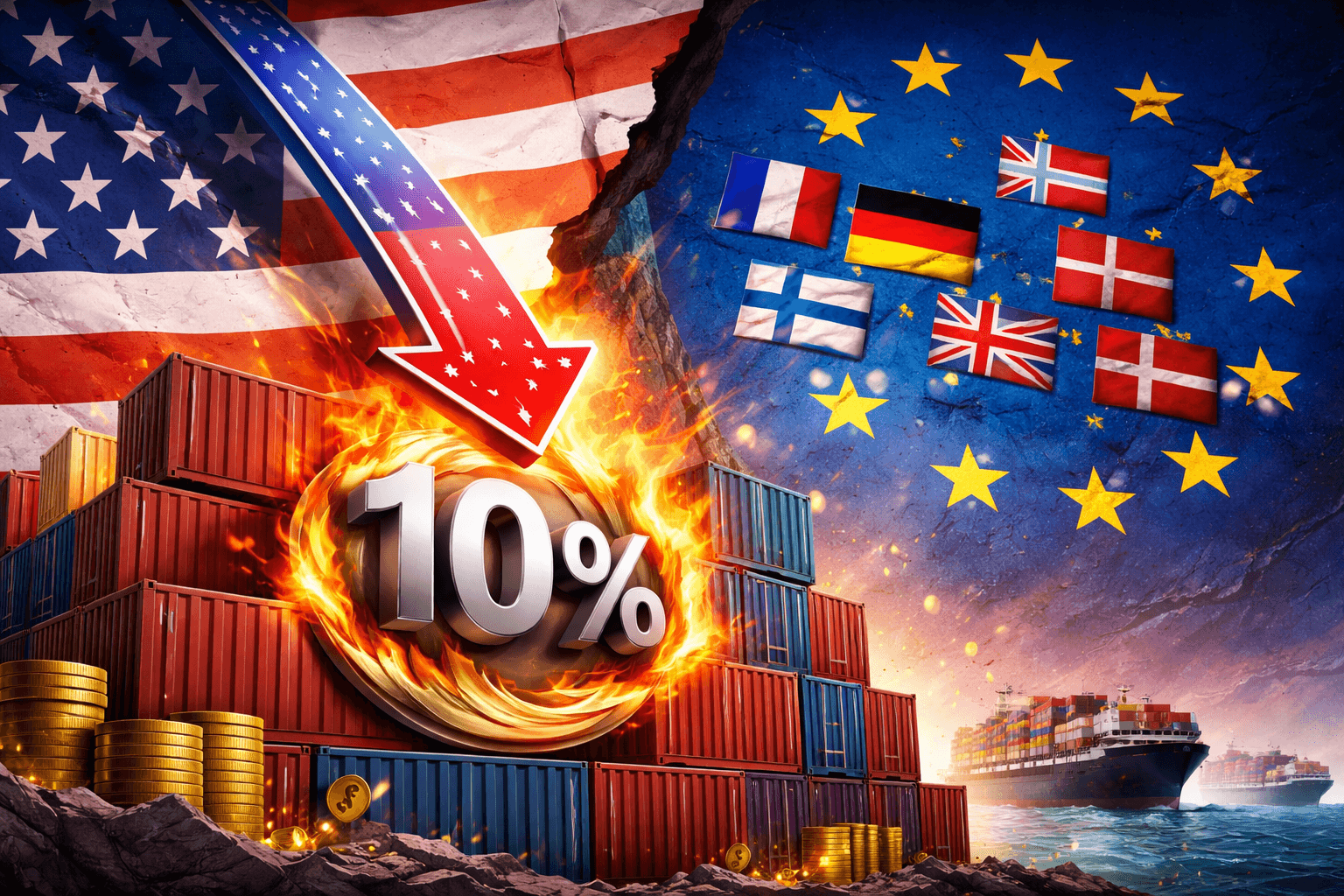
Senate Democrats Propose Legislation to Halt Trump’s Tariffs on European Nations Over Greenland Dispute
Senate Democrats push back against President Trump’s proposed tariffs on European nations, escalating tensions over the U.S. pursuit of Greenland’s acquisition.
Fact Check
The assessment is based on high-authority sources which point to a well-documented trade action. The Financial Times, a top-tier source on this topic, and the Hoover Institution's mention of the 'Airbus' dispute provide strong evidence that the Trump administration did impose tariffs on European nations.In October 2019, following a World Trade Organization (WTO) ruling regarding illegal subsidies for Airbus, the Trump administration enacted tariffs on $7.5 billion worth of EU goods. These tariffs included a 10% levy on aircraft, which directly aligns with a key part of the statement. The aircraft tariffs primarily impacted the countries central to Airbus manufacturing: France, Germany, Spain, and the United Kingdom (which was an EU member at the time).The statement's claim of "eight European nations" is plausible, though it simplifies a complex situation. While the 10% tariff focused on the four Airbus-producing nations, the same trade action also imposed 25% tariffs on a wide range of other goods (like wine, cheese, and whiskey) from various other EU countries. It is conceivable that the statement is referring to a specific list of the most affected nations which could total eight. While the statement omits the existence of the 25% tariffs, its central claims—that the Trump administration imposed 10% tariffs on European nations—are factually correct. The potential imprecision regarding the exact number of nations does not render the statement false, but rather a simplification of the full scope of the tariffs. The evidence strongly supports the core of the claim. Irrelevant and fabricated sources (4 through 10) were disregarded as they offered no factual information on the topic.
Summary
On January 18, Senate Democrats introduced legislation aiming to stop President Donald Trump’s planned tariffs on European nations—Denmark, Norway, Sweden, France, Germany, the UK, Netherlands, and Finland. The tariffs, starting at 10% on February 1 and increasing to 25% by June 1, are part of Trump’s strategy regarding the U.S. annexation of Greenland. The European Union has called an emergency meeting to address the issue.
Terms & Concepts
- Tariff: A tax imposed by a government on imported goods, often used to influence trade policy or negotiations.